Crypto Mining Explained: A Comprehensive Guide
Table of Contents
Crypto mining is a vital process in cryptocurrencies, especially in proof-of-work networks like Bitcoin. This guide will explain crypto mining, the process of Bitcoin mining, and its profitability. We'll also delve into mining hardware, mining pools, and the environmental impact of mining.
Understanding Crypto Mining
Crypto mining involves solving complex mathematical puzzles to validate transactions on a blockchain network. Miners use powerful computers to compete, with the first to solve these puzzles adding a new block to the blockchain. This process is essential for maintaining network security and decentralization.
Key Concepts in Crypto Mining
Here are some crucial terms and components in crypto mining:
- Crypto Mining: Validates transaction records and adds them to a public ledger (blockchain).
- Block: A collection of transactions confirmed and added to the blockchain.
- Hash Rate: Speed at which a miner solves cryptographic puzzles; measured in hashes per second.
- Mining Difficulty: A measure of how hard it is to find a new block, adjusted periodically.
- Proof of Work (PoW): Requires miners to perform computational work to validate transactions.
How to Build a Mining Rig
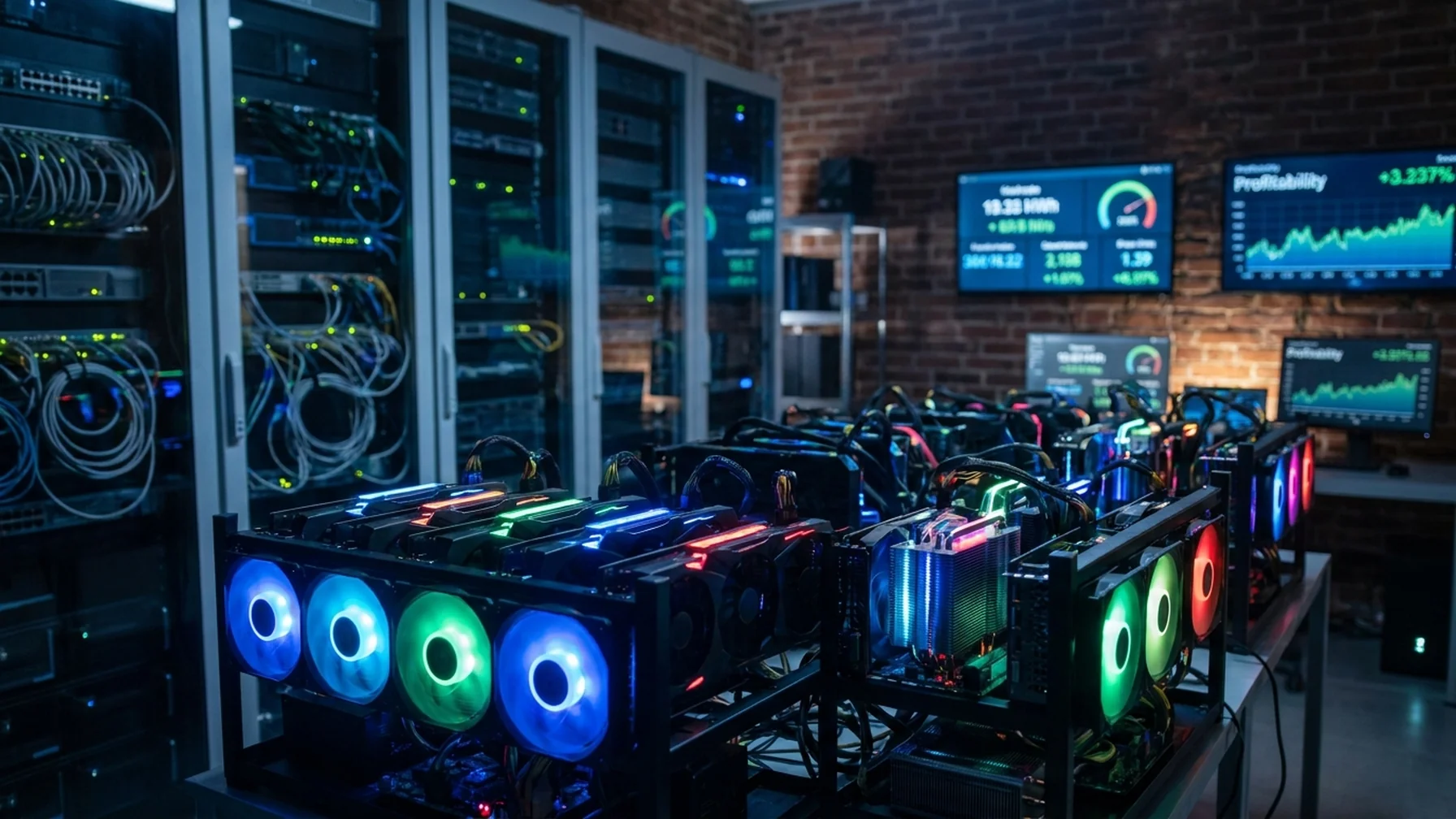
Building a mining rig requires careful selection of components and proper assembly. Each part plays a vital role in ensuring the rig's efficiency. Understanding these components helps in making informed decisions.
- Choose the right GPUs or ASICs based on your budget and power availability.
- Select a compatible motherboard and power supply to support your components.
- Implement cooling solutions to prevent overheating and maintain performance.
- Install mining software and join a mining pool to start mining efficiently.
Proper assembly and configuration are crucial for optimizing performance and minimizing downtime.
GPU vs ASIC Mining Rig Options
Here's a brief comparison of GPU and ASIC mining rig options:
| Component | GPU Mining Rig | ASIC Mining Rig |
|---|---|---|
| Initial Cost | Moderate | High |
| Flexibility | High (versatile) | Low (dedicated) |
| Power Consumption | Variable | High |
| Mining Efficiency | Moderate | Very High |
Considering these factors can help you decide whether to invest in GPUs or ASICs, depending on your specific needs and resources.
How Does Bitcoin Mining Work?
Bitcoin mining relies on a proof-of-work system, where miners solve computational puzzles. These puzzles require significant power, securing the network by making it difficult for any single entity to control the blockchain. Miners earn newly created bitcoins and transaction fees for their efforts.
Is Crypto Mining Profitable?
Crypto mining profitability depends on several factors, including hardware costs, electricity prices, and cryptocurrency value. While mining can be profitable, it requires significant investment and ongoing expenses. Calculating profitability involves comparing costs against potential earnings.
Proof of Work Explained
Proof of work is a consensus mechanism used in many cryptocurrencies, including Bitcoin. It ensures miners expend effort through computational power to validate transactions. This prevents tampering, as altering a block requires redoing the work for subsequent blocks.
Can You Still Mine Bitcoin at Home?
Mining Bitcoin at home is challenging due to increased difficulty and competition. Many home miners find solo mining unfeasible and join mining pools to combine resources and share rewards. Some enthusiasts still mine at home for educational purposes or as a hobby.
Mining vs Staking
Mining and staking are two methods to secure blockchain networks. Mining involves solving puzzles for transaction validation, while staking requires holders to lock their coins in a wallet to support network operations. Staking is often seen as a more energy-efficient alternative to mining.
Environmental Impact of Crypto Mining
Crypto mining is energy-intensive, with significant electricity consumption. Miners need to account for electricity costs when calculating profitability. Innovations like energy-efficient hardware and renewable energy sources are being explored to reduce environmental impact.
Mining with Renewable Energy
Mining with renewable energy, like solar power, reduces reliance on traditional electricity sources. Solar panels can power mining rigs, cutting costs and reducing the carbon footprint. However, the initial investment in solar technology can be substantial.
What is Mining Difficulty?
Mining difficulty measures how hard it is to find a new block. As more miners join the network, difficulty increases to maintain a consistent block creation time, ensuring the security and stability of the cryptocurrency network.
The Bitcoin Halving
The Bitcoin halving event occurs approximately every four years, reducing the reward for mining new blocks by half. This mechanism controls Bitcoin's supply, impacting miners by reducing their earnings. However, it also historically affects Bitcoin's price due to reduced supply growth.
What Happens When All Bitcoin is Mined?
Once all 21 million Bitcoins are mined, miners will rely solely on transaction fees for revenue. This shift emphasizes the need for an efficient and secure network to maintain transaction validation. The transition marks a new phase in Bitcoin's lifecycle.